
How to Start Playing Riffs, Scales, and Lead Guitar Like a PRO!
If you’ve been strumming chords for a while and want to break into solos, congratulations you’re at one of the most exciting points in your guitar journey!
This how to start playing riffs, scales, and lead guitar like a PRO will help you make that leap from rhythm to lead playing opens up a world of creativity and expression. But it can also feel like a mystery: where do you even begin?
Let’s break it down step by step.
Learning to SOLO Like A Pro!
Step 1: Understand What You’re Actually Doing!
When you play chords, you’re already using scales you just don’t see them yet.
Every chord is built from specific notes in a scale. When you move into riffs or solos, you’re simply focusing on single notes rather than full chords.

This can sound like magic but its really pretty easy to get started! What’s important is to listen to the music your soloing over. This is your reference for tonality, speed and tension in your playing.
It feels like many people just go oh I’m in the key of Am and just shred! It can be like that, but how does it sound? Does it add to the song, or is it just a mess of fast notes!
You have to decide what your aiming for!
Personally I think Slash has the best feel of anyone when it comes to soloing. In his case he adds layers notes that fit to the song and give it colour. With his solos he adds a personal feel and rhythm where many other players create great solos but they are like a separate part of the song and not within the song. Again it depends on your perspective because all of this is very objective. My amazing solo may be boring to you. That’s ok too!
Think of soloing like zooming in on the chords which are the “big picture,” riffs and solos are the details inside that picture.
You might say SOLO’s are the sauce on a great meal!
Step 2: Learn Your First Scales – Make Music With It.
Most guitarists start with the minor pentatonic scale (often in the key of A).
It’s easy to memorize, works with tons of songs, and the pentatonic sounds instantly “right.” Its super flexible and I have been using it for 20 years in my own playing.
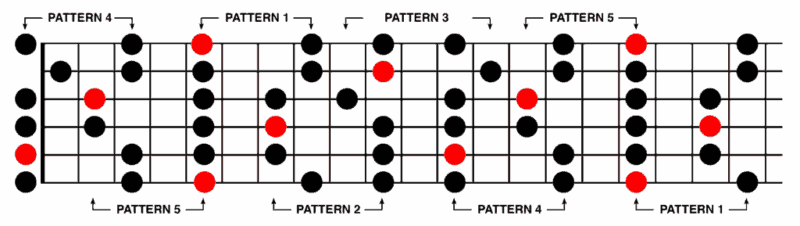
Below the diagram shows the A Minor (Am) pentatonic scale. The bottom is the BIG E string and the top of the diagram is the THIN E string for reference. The numbers are the fret position on that string.
This is referred to as Pattern 1 of the five in the key but I’m going to help you expand your playing options solely with this one box! Yes you’ll be amazed a minute what you can really achieve solely with this basic pattern.
You’ll look like a pro play all over the neck with this one box!
🎵 A Minor Pentatonic Scale Pattern:
e|----------------------5-8-
B|------------------5-8-----
G|--------------5-7---------
D|----------5-7-------------
A|------5-7-----------------
E|--5-8---------------------
👉 Don’t just run it up and down, make it musical give it space and some of the techniques we will discuss below.
Thinking Musically – Lets Learn Some Techniques.
Music needs space, so sometimes leaving some empty space makes the next note even more important. You DONT HAVE TO FILL EVERY MILISECOND WITH A NOTE when soloing. Let the song breath and let your solo colour it like a set of incredible coloured pencils in a masterpiece.
Tone – Sad or Happy – It’s Your Choice!
The pentatonic pattern above is the A minor pentatonic scale and this adds a somewhat sad tone to the solo. Very bluesy or rock based if you like. Often played over minor chords but not exclusively. We will discuss options in a moment.
Time to Colour that Picture.
Try bending a note, repeating patterns, or adding slides. Play along with a simple backing track and see how each note “feels” different.
The flavour is very unique when bending a note as well as how you play vibrato. This is when you shake the note with either a longways or sideways movement of your finger. This makes the note shimmer a little.
🪶 Step 3: Start with Riffs You Already Know
One of the best ways to bridge chords and scales is to learn famous riffs they’re the perfect middle ground.
Riffs are basically mini solos that often connect rhythm and melody that repeat in a song like a chorus. Its likely the part you recognise first in a song. You hear the riff and immediately know its that song. There are so many legendary riffs from all walks of music from Sweet Home Alabama’s riff or Sweet Child of Mines by G n R classic opening riff and of course the riff banned in all guitar/music stores from Stairway To Heaven – Denied! 🙂
These riffs can be quite complicated and then they can be so simple its ridiculous!
Try these for starters:
- “Smoke on the Water” – Deep Purple
- “Sunshine of Your Love” – Cream
- “Seven Nation Army” – The White Stripes
Sunshine of Your Love by Eric Clapton!
This is an amazing riff by Eric Clapton when he was in CREAM. I’ve played this song in bands and it was really well received. Always a “WOW” reaction or Yeah! When we hit that initial riff. This is how Eric Clapton plays it when you see the Cream play it live on YouTube. My version of it is below so you can see there’s more than one way to skin a cat!
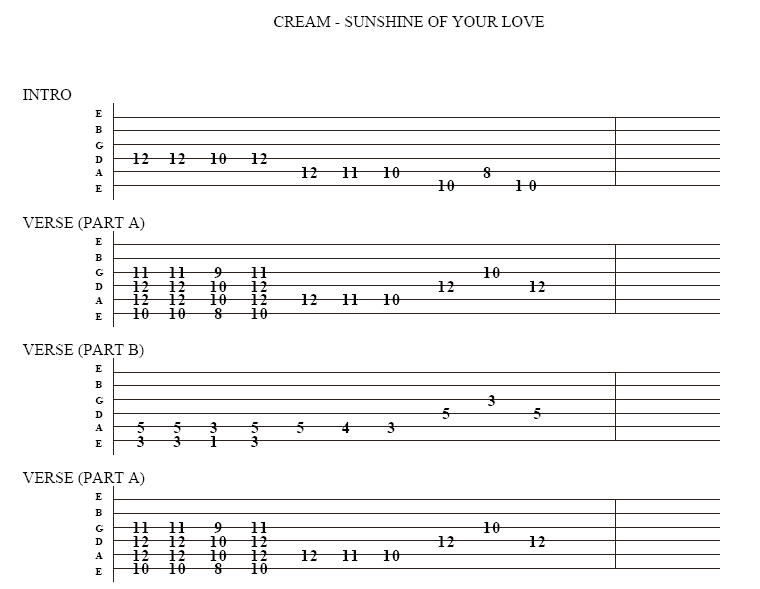
Notice how these riffs often use simple scale shapes, rhythm, and repetition. Mastering a few will teach you timing, groove, and how riffs sit between chords and solos.
You can create your own versions and in my case I played it like I have tabbed it below. It sounds great and in the lower register is fuller to me this way. But I thought Eric alternated the final three notes of the riff so I played it like it is below.
E————————————–|—————————————-
B————————————–|——————————9——–
G————————————–|————————-10—10—–
D–5-5-3-5 ————-3-——-|—-5-5-3-5————————
A–5-5-3-5———–5—-5——|—-5-5-3-5————————
E————5-4-3——————|——————5-4-3————-
D D C D D D C D
You can Play a basic D Barr Chord and if you play just Power chords which is the A & D strings only you can simply pull off your third finger to get the lower C chord and not move at all. Economy of movement! You can move between the chords of you like. Its up to you!
Just a Note that I believe the solo is played in D Minor Pentatonic – That’s where I played as I remember and it pretty much note for note! It’s not super hard and no I’m not Eric Clapton. Great Solo though!
🧭 Step 4: Link Chords and Scales on the Neck
This is where things get exciting connecting chord shapes with the notes of your scale.
For example, if you’re playing an A minor chord, the A minor pentatonic works perfectly over it.
Try this:
- Strum the chord once or twice.
- Then play a few notes from the scale that fit the same key.
- Switch between rhythm (chords) and single notes (lead).
This teaches your ear how the two worlds connect.
Ok at this point I would recommend a backing track and the Am pentatonic scale. Now the Am pentatonic shape is pretty flexible and how you use it varies between players! If you get a basic Am backing track on YouTube and get a slow one to start then you can play the first position Am pentatonic scale over it.
Here’s a good example for you to check out. I like it when I’m in that mood! Long slow bends with vibrato at the top of the bends and hold them long so they draw every ounce of passion from you.
Step 5: Make Solos Musical, Not Just Fast
A common beginner mistake: thinking that soloing means shredding.
In reality, a great solo tells a story it has emotion, space, and direction.
Here are a few musical soloing principles:
- Start simple: even two or three notes can sound great with expression.
- Use bends, slides, and vibrato for character.
- Phrase like you’re singing leave gaps, build tension, resolve.
Expression – What is it? You can simply play a note. That’s simple and did it sound ok? So that’s a note in its most basic form! lets expand on this with some basic techniques that you can eventually combine to make some incredible music.
SLIDE ME!
E|————-7/9—————| ← Slide up from 7 to 9
E|————-9\7—————| ← Slide down from 9 to 7
E|————-7s9—————| ← Alternative slide notation
A slide is the simplest form of expression. You can play a note then holding your finger on it slide either down or up the fretboard to get a new effect. Do this slowly or fast as it has different effects on the note.
It’s important to try and stop at a note also in the scale if you can but you could slide up or down then bend the note to get it into the scale as well. Yes you can!
Ok now play it and rock your playing had till the note shimmers a bit. Now see what happens by shaking the wrist sideways and long ways. You will here distinctly different vibrato effects. Try it!
BEND a NOTE
E|————-7b9—————| (Bend up from 7 to 9th fret note.)
E|————-9r7—————| Prebend the 7th fret note up to the 9th fret then release it)
E|————-7b9r7————-| Bend the 7th fret note up to the 9th fret note then release.
E|————-(7)b9r7———–| Prebend the 7th fret note up to the 9th fret then release it)
Ok Lets Bend a note. Bending notes can be done with any finger so don’t just use that 3rd finger and remember the 1st also can contribute! You can push the string up till it meets the tone of the next note in the scale! Now shake it and let it vibrate too! Now you have a bend and a vibrato!
Ok while its there don’t let it down jet! Play the note once its silent and let the string return to its original place! It sort of cried didn’t it! This is a release bend. Very powerful and beautiful in the right place.
VIBRATO
E|————-7~————-|
Vibrato adds a shimmer to the note you play. You could bend a note then add vibrato or slide to a note and then add vibrato. Its also very powerful. Ok, what’s vibrato since we are talking about how to implement it?
Its simply shaking the string so the note goes in and out of tune really. It creates a shimmering effect to the note.
Its done by rocking your finger either side to side or sideways up and down. You will immediately hear the note change. David Gilmore is a master at the long bend and vibration in combination. Its incredible!
You now have the keys to the Ferrari but can you drive it? Take your time and just have fun with it! Don’t stress if you get a few bad notes as your learning.
Listen to players like David Gilmour, Mark Knopfler, or B.B. King as they do more with five notes than some can with fifty. Its not quantity but quality!
Hammer Me!
E|————-7h9—————| Hammer from 7th to 9th fret.
E|————-9p7—————| Pull Off from 9th note to 7th note.
E|————-7tr9————–| Rapidly repeat the Hammer on & Pull Off.
Hammer On’s and Pull offs are yet another flavour you can add. In this example Play a note with your first finger on a string then hammer your 2nd or 3rg finger down on the following fret. You get a rapid note change and this is where the fast trills you here often come from.
Pull Off’s are the reverse where you play the higher note then pull your finger off sharply with the lower finger already in place when makes the note drop in pitch quickly.
Hammer On / Pull Off. This is combining the above two actions into a single and often continuous series of fast hammer on to pull offs repeated. This sounds amazing in the right place.
There are more techniques but since your just getting started this is more than enough!
Even More Secrets!
Ok, since you’ve got this far with me let me, thanks! Lets make you look like a pro in a minute or so! The Am pentatonic scale also has a close family member called the Major A Pentatonic Scale!
Oh yes, and all you have to do is play the same exact shape you were at the fifth fret but at the 2nd fret or simply slide back 3 frets! Now your in A Major Pentatonic. That’s easy eh! Its a totally different feel!
The tone will be a little happier which can be great to change the feel of a solo.
Resolution!
Solos need to resolve that is they need to have points between sections that say I’m finished now! This is mostly achieved by playing a ROOT NOTE! In this case its the A note which are highlighted on the Am Pentatonic graphic in this blog post. Check it out where the red dots are and they are the target mostly!
Double Your Notes – Go Up the Neck!
Now you may have noticed the two double fret markers up the neck! Yes? Do you know what they are!
Its the start of the second octave on your guitar, so If your playing Am pentatonic on the fifth fret then slide up to the 17th Fret and your playing Am pentatonic an octave higher than you were a minute ago! Awesome Ah!
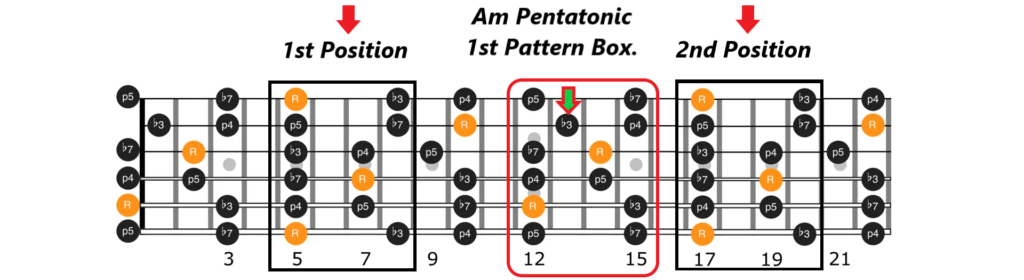
Yep, and the same applies for the A Major pattern now an octave higher on the 14th fret! In a minutes you just doubled your playing positions, tone and pitch without having to learn another pattern!
You can absolutely go wild now with moving from Low to High and your friends are going to think HELL he/she’s learnt a lot in no time! Lets keep the secret to us ok!
Don’t tell them or that takes away the fun of them being amazed! 🙂
12th Fret Am – More Flexibility!
Ok, look back at the diagram above and look specifically at the GREEN BOX which we have not yet talked about. You may notice that its nearly identical to the standard Pattern 1! The single difference is the one note on the B string I have an arrow too!
So now you have the Following THREE Positions to Play FIRST BOX Am PENTATONIC Scale!
A Minor (Am) Pentatonic Box 1:
- 5th Fret Root Note (A)
- 2th Fret Root Note (F#)
- 17th Fret Root Not (A)
A MAJOR (Am) Pentatonic Box 1:
- 2nd Fret Root Note (F#)
- 9th Fret Root Note (C)
- 14th Fret Root Note (F#)
Major & Minor Scale Comparison
Breakdown of the A Major Pentatonic Scale
Notes: A – B – C♯ – E – F♯
Scale Degrees:
1st (Root): A
2nd (Major 2nd): B
3rd (Major 3rd): C♯
5th (Perfect 5th): E
6th (Major 6th): F♯
Formula: 1 – 2 – 3 – 5 – 6 (omits the 4th and 7th degrees of the full major scale)
Breakdown of the A Minor Pentatonic Scale
Notes: A – C – D – E – G
Scale Degrees:
1st (Root): A
♭3rd (Minor 3rd): C
4th (Perfect 4th): D
5th (Perfect 5th): E
♭7th (Minor 7th): G
Formula: 1 – ♭3 – 4 – 5 – ♭7
(Omits the 2nd and 6th degrees of the full natural minor scale)
All the Keys!
There are some very common additional notes used from the previous box pattern and to next Pentatonic boxes which are very worthwhile to add to your repertoire.
The little house is a very useful couple of extra notes on the high E – B & G strings with a root note here gives you another place to resolve a run or section in your solo.
In addition the Notes on the third fret with the arrow are also additional and useful places to go. Practice and you will understand!
HERE !
\/ \/ \/ \/
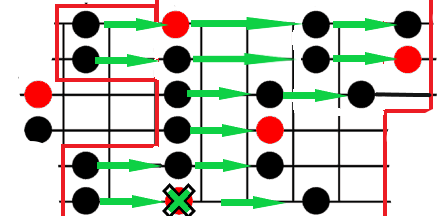
The Scale Shape above is the Basic Pentatonic Shape and if you place the RED DOT Green X which is the Root Note of the scale on the 5th Fret then If you use the guide above you’ll easily never need any notes while your starting your initial solos!
🧠 Step 6: Practice Creatively
Don’t just “practice scales.”
Instead, build small musical challenges:
- Download or listen to a YouTube Backing track in Am. Slow speed at first.
- Try playing notes with the variations above and have fun!
- Record yourself and listen to your own progress. Recoding and listening to your playing is very honest. There are no excuses, but you will improve!
Over time, you’ll develop the ability to see riffs and solos within the chords you already know.
⚡ Final Thoughts
Moving from chords to riffs and solos is less about memorizing hundreds of scales and more about connecting ideas you already understand. The use of just one box of notes in the Minor Pentatonic Scale will as we have discussed open the whole fretboard nearly and have you playing the whole neck to onlookers! I hope this was as useful as I find it when playing.
If you can strum a chord, you already have what you need to start playing melodies inside it. Keep it fun, focus on sound and feel, and celebrate the small wins. Before long, you’ll go from rhythm player to expressive lead guitarist without even realizing it.
The Author.
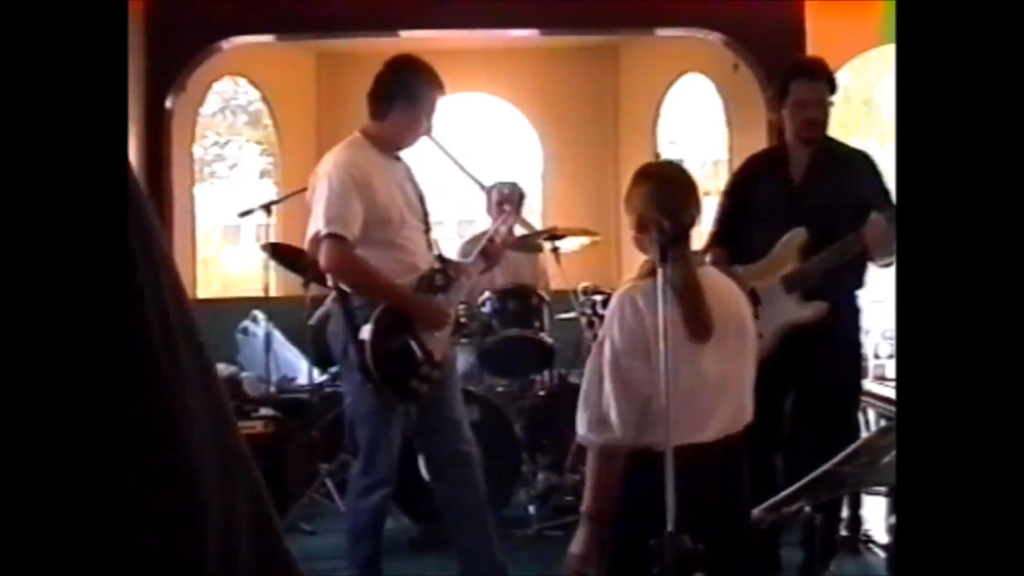
Brendon McAliece is a multi lingual expatriate Australian living in Thailand who speaks Thai, a number of its dialects and Lao. He has been playing guitar since he was 12 and continues to do so to this day.
He has performing in bands across the Middle East while contracting as a Aircraft Weapons Instructor with his 10 years of RAAF Armament Fitter experience and his maintained his love for playing guitar it continues to thrive today.
Also Visit:
DreamingGuitar.com – DreamingCoffee.com – LetsFlyVFR.com
As an Amazon.com affiliate I may earn on qualifying sales.
