

How to Solo Major to Minor Pentatonic Scale for Beginners Tutorial.
Learning how to solo is an amazing journey for a guitarist. Its often the place where skill, passion and creativity all come together. The scary part for those considering getting into the world of soloing and being that Eddie Van Halen lead guitarist is the mountain of scales we believe we need to learn.
In fact its not really true in the beginning! Maybe latter you may expand but for now one is all you need! Lets make this initial journey simple! I’ll have you soloing over a majority of the guitar neck after this single blog post.
I feel confident I can make this claim truly come to fruition.
The Pentatonic Scale is the Keys to the Ferrari!
Lets start with the favourite of most guitarists with the Major and Minor Pentatonic Scale. These two scales are EXACTLY THE SAME when using the box scale method! They just start at a different place on the fretboard but can quickly and easily be mixed together in a solo.
The pentatonic scale is a five note scale so it omits a couple regular notes. It is essentially made up of five boxes of notes so we can learn these one at a time to become professionally. Lets start with Box 1 and ill show you the incredible amount you can actually do with it!
Pentatonic Box 1 – Life Starts NOW!
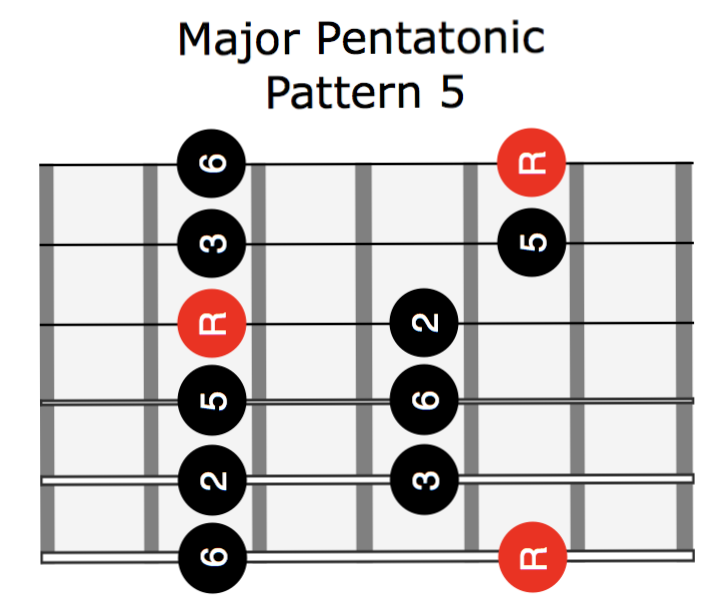
The diagram shows the makeup of the First Major Pentatonic box 1. You will never forget this box as its often the start point for all your work to come.
In the diagram take note of the RED DOTS. These are the Root notes of the key! In this example we are using the key of C so its a C note. It’s often the place retreat to after a few bends and some vibrato to resolve the passage we have played.
What is a Root Note?
Root notes are the main note or the name of the scale. If we are using C Major scale then the Root note starts on the 8th fret of the thick or low E string and is a C note. In this case the root note we are talking about is the C note.
Notes in C Major vs C Major Pentatonic
Please note the diagram above and understand the string at the top of the picture is the thinnest E string and the one at the bottom is the Thick E string closest to you when holding the guitar.
Inside this moveable pattern you can see three red notes. Anytime your soloing its most often initially in the beginning to end a section of a solo on one of these notes! This gives the section a place to resolve or finish. It just sounds right! You will likely find other options latter but for now lets just focus on the red dots.
| Scale Type | Notes | Description |
|---|---|---|
| C Major Scale | C – D – E – F – G – A – B | Full 7-note diatonic scale; includes all natural notes, no sharps or flats |
| C Major Pentatonic | C – D – E – G – A | 5-note scale omitting the 4th (F) and 7th (B) to avoid semitone tension |
Major & Minor! Why are they the Same?
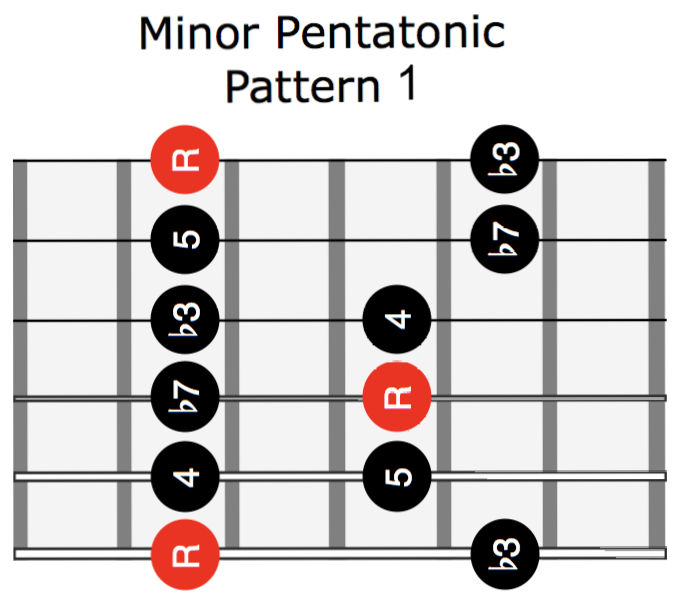
What you may have noticed is the two diagrams labelled Major Pentatonic and Minor Pentatonic are the SAME! Yes they are exactly the same shape but have some different notes in reality. They are in separate places on the fretboard but can be used together easily.
But noticing this has already doubled your soloing options and in a moment I’m going to double them yet again without giving you anything extra to learn!
Yes you can play in the C Major or C Minor Box 1 positions in the same chord progression as below.
Minor to Major C Pentatonic Positions.
I just said you can use these two Minor and Major Pentatonic boxes at the same time over the same chord progression. Yes you can!
I have included a Slow Blues progression to give you something to try while reading this post. Maybe this is time to lean over and grab your guitar. Its time to go to work!
Try playing the Minor Pentatonic Scale with the root on the thick E string at the 8th fret. This is C Minor pentatonic Position. If you haven’t already just play across the scale from the thick E to the thin E string. Play sequentially down and back.
E————————————-8–11—11–8————————————
B——————————8–11—————-11–8——————————
G———————–8–10—————————–10–8————————
D—————-8–10——————————————-10–8—————-
A———8–10———————————————————10–8———-
E -8–11————————————————————————11–8—
In this exercise you play forward if you like going low to high and then come backwards returning high to low on the strings. I recommend doing this until you are smooth and even in your playing.
The reverse of this is also a good exercise to build coordination between your picking hand and your fretting fingers. Go slow and get it nice and smooth. Going fast often means you make mistakes you have to unlearn latter.
This exercise have you start on the ROOT NOTE and finish also on the root note. If you don’t you may notice it sounds like its not finished. This is why i suggest this way.
E————————————-11–8—8–11————————————
B——————————11–8—————-8–11——————————
G———————–10–8—————————8–10————————–
D—————-10–8—————————————–8–10——————-
A———10–8——————————————————-8–10————
E 8-11-8——————————————————————–8-11-8—
How to Move from Minor to Major Pentatonic.
The change from the current C Minor Pentatonic Box 1 shape to the C Major Pentatonic shape simply move the whole shape back three steps! Yes back toward the nut to in this case the 5th fret and A position.
Now your in the C Major Pentatonic scale and you will defiantly hear a difference in the way it sounds. It should have more of an upbeat happy sound as opposed to soulful Minor Pentatonic sound.
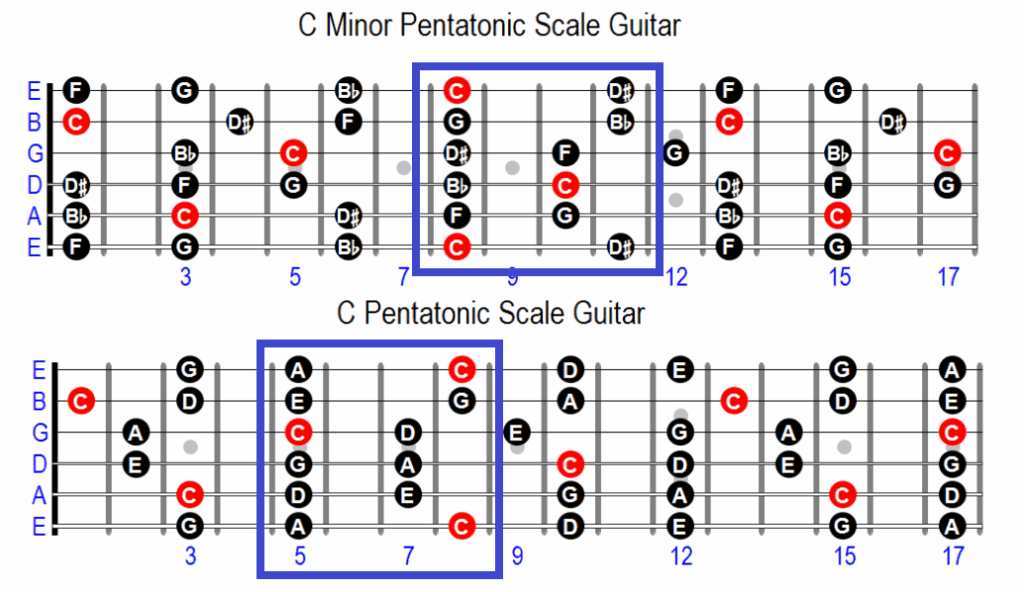
It does have a few different notes and the ROOT NOTE C which is still important but is now in different locations in the BOX 1 Pattern. Its time to take it for a drive!
Lets Double Your Options & MORE!
Wow! We have come a long way already with so little! Who said you needed a full fretboard knowledge to get started. Well lets open the fretboard even more for you and double your options.
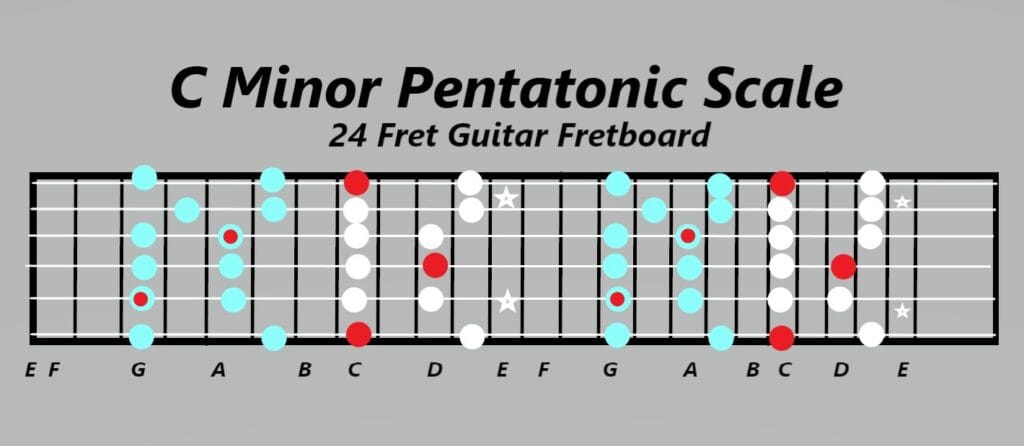
The diagram shows a new pattern in BLUE and as you can see this is nearly identical to the Minor pentatonic Box 1 we have been using. The B string or 2nd from the top of the diagram has a different position.
This is also very easy to add to your standard box 1 Pentatonic. Now you have doubled your MINOR PENTATONIC knowledge! Yes it also applies above the double dots at the 12th fret. All the Red dots are the ROOT NOTE C for your soloing reference.
The same applies in that it repeats in the same relative position to the Minor pentatonic scale.
Play Your First Solo in C!
The C Scales is a great default place to start our soloing journey. The notes in C Major are all pure notes and that is to say there are not flats or sharps in the scale.
Lets Start with the BOX 1 Minor Pentatonic box with the root note being C.
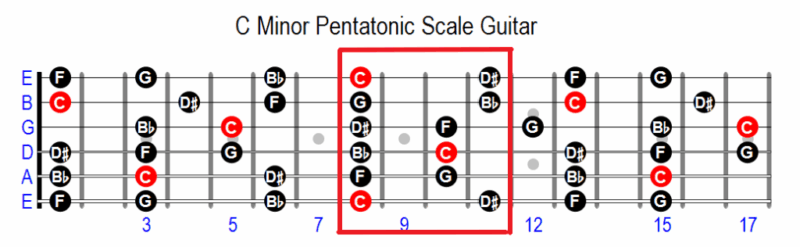
The Scale above is the C MINOR Pentatonic Scale! Note the Root Note on the LOW E string is on the 8th fret. This is the C Note and regarded as the Root of the scale. Its our start point! The red highlighted notes are the root notes ie C.
You can start soloing in this box over a C Chord progression like a Blues in C. This would be a I – IV – V or 1-4-5 progression being a C – F – G chords. In the scale these are Major scale so they will sound happy when played.
Here is a Slow C Blues Progression for you to practice over while we work our way through this lesson.
Lets Major this Solo!
So we just played with the Minor Pentatonic scale in C now we will move back three frets and try it all over again. It will sound different bit it will be great!

Now take your C Major First box 1 Pentatonic scale up to the fretboard if you have enough frets that is to the 20th Fret where this box can be reused!
REVIEW
Ok in review lets go once again over where we can play the BOX 1 Minor Pentatonic Scale in the Key of C as well as the Major Pentatonic Position in the key of C as well. We are playing two different scales but their patterns are the same and interchangeable depending on how they sound.
You may find the major does not fit as well depending on the chords used in the backing track or song. Experiment!
Conclusion
I hope this C Minor Pentatonic & C Major Pentatonic Scale BOX 1 blog post has opened your eyes to where the scale is, how it looks and how easy it is to utilise. If you cave comments or questions please post them below and I’ll get back to you.
The Author.
Brendon McAliece is a multi lingual expatriate Australian living in Thailand who speaks Thai, a number of its dialects and Lao. He has been playing guitar since he was 12 and continues to do so to this day.
He has performing in bands across the Middle East while contracting as a Aircraft Weapons Instructor with his 10 years of RAAF Armament Fitter experience and his maintained his love for playing guitar it continues to thrive today.
Also Visit:
DreamingGuitar.com – DreamingCoffee.com – LetsFlyVFR.com
As an Amazon affiliate I may earn on qualifying sales.
Leave a Reply