

Learning Guitar Chords for Beginners the Key of C.
Learning Guitar Chords is the first step to playing your first song because this specific Key of C Major has not Flat or Sharp notes. So lets look at the chords you need to know and then we will look at a little music theory so you understand the makeup of the key of C itself, the degrees if the notes which also applies to scales which we will look at in other posts.
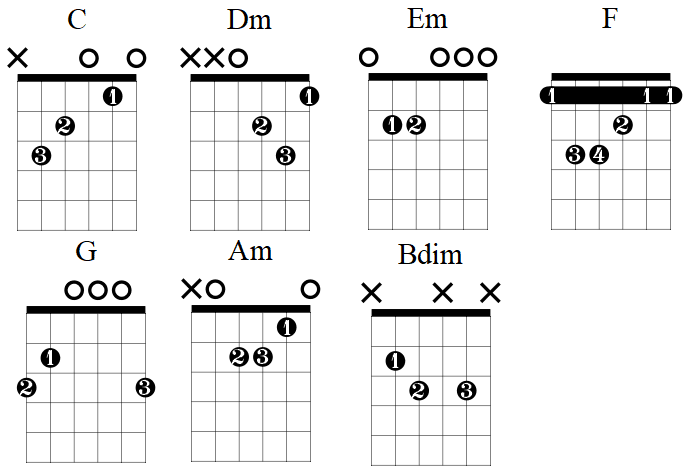
Absolutely! Here’s a clear and practical chord chart for the C Major scale, showing the diatonic triads built from each scale degree:
C Major Scale – Diatonic Chord Chart
| Scale Degree | Note | Chord Type | Chord Name | Notes in Chord |
|---|---|---|---|---|
| I | C | Major | C Major | C – E – G |
| ii | D | Minor | D Minor | D – F – A |
| iii | E | Minor | E Minor | E – G – B |
| IV | F | Major | F Major | F – A – C |
| V | G | Major | G Major | G – B – D |
| vi | A | Minor | A Minor | A – C – E |
| vii° | B | Diminished | B Dim | B – D – F |
As you can see in the chart above there are no Sharp of Flat chords.
🔍 Tips for Use
- These chords are all diatonic to C Major (no sharps or flats).
- The I–IV–V chords (C, F, G) are your primary major chords.
- The ii–iii–vi chords are minor and great for progressions.
- The vii° diminished chord adds tension, often resolving to I.
In the makeup of the Key of C there are a mix however of Major and Minor chords which can give a song a different feel. In general terms the MAJOR CHORDS are HAPPY sounding when used. They make a song up beat and fun to listen to.
The difference is the MINOR CHORDS which make the song sound SAD or BLUESY.
The scale degree you see in the diagram tells us the order of the chords in the specific key and assigns them numbers. These numbers are used by musicians often when talking about a songs makeup.
Popular Chord Progressions.
Lets look at some examples. A standard rock progression often uses the I – IV – V or 1-4-5 progression. In the Key of C that means the chords C – F – G are being used.
This is a simple 1-4-5-6 progression. Incredibly popular for sure. The songs using these simple chords in this progression have sold hundreds of millions of records over the years and has been used going back more than 100 years in music.
In the key of C major we’ll treat the four chords as:
- C (I)
- G (V)
- Am (vi)
- F (IV)
Here are ten songs that you would likely know that use just this progression.
- “Don’t Stop Believin’” – Don’t Stop Believin’ by Journey
- “You’re Beautiful” – You’re Beautiful by James Blunt
- “Where Is the Love?” – Where Is the Love? by The Black Eyed Peas
- “Forever Young” – Forever Young by Alphaville
- “I’m Yours” – I’m Yours by Jason Mraz
- “Hey, Soul Sister” – Hey, Soul Sister by Train
- “Wherever You Will Go” – Wherever You Will Go by The Calling
- “Can You Feel the Love Tonight” – Can You Feel the Love Tonight by Elton John
- “Paparazzi” – Paparazzi by Lady Gaga
- “With or Without You” – With or Without You by U2
Practice.
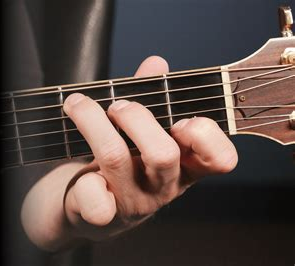
These chords are also reasonably easy to move between as the shapes move only a little. If you start playing a C Chord you should listen that each note is clear and not muffled in any way. You achieve this by having the finger tips pushing down vertically and fretting the note i.e. placing your finger close to the back of the fret.
This means the note will be clear and you don’t have to push as hard to get the note you want. Having a good arch over the fretboard will assist in not touching any strings not required.
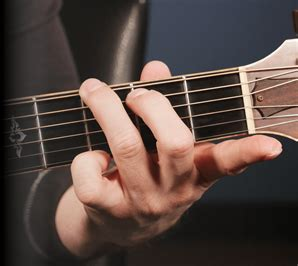
In the diagram adjacent you can see the fingers come down vertically on top of the string. You can also see there fingers are mostly straight so they don’t lay down on the next string making it sound poor.
Am to C is an easy transition because you need only move those two lower note strings up one fret each to the lower (Sounding) string. We talk in lower strings being the lower sounding strings not the lowest in position on the fretboard. The thick ones are lower and the thinner ones are said to be higher strings just to be clear.
C to G Transition!
From the picture above you can see the 2ns and 3rd fingers for a slight slop upwards. To transition from the current C chord to G chord simply move both the 2nd and 3rd fingers up together all by one string. At the same time take for first finger off the 2nd string and lower your pinkie down on the thin E string at the 3rd fret.0
Its a very smooth transition normally and beginners don’t take long to be able to do it. You should have down in not much time at all. Just play from C then to G then back to C initially.
Go back and forward and try to do this slowly with a four down strums / / / / then change to the next chord / / / / then back to C / / / /.
The next exercise could be Am to C to G. A simple one with limited movement. Once your getting comfortable then try other chords from the list above.
Blues Progression
The basis for Blues & Rock is often found in a 1 – 4 – 5 Progression. This will introduce you to a basic song format. Not all blues songs follow this strictly but its a great place to start. Each / / / / is 4 down strokes for now!
Blues in C Major.
C C C C
//// //// //// ////
F F C C
//// //// – //// ////
G F C G
//// //// – //// ////
Counting – 12 Bars of 4 notes.
1 2 3 4 – 1 2 3 4 – 1 2 3 4 – 1 2 3 4
1 2 3 4 – 1 2 3 4 – 1 2 3 4 – 1 2 3 4
1 2 3 4 – 1 2 3 4 – 1 2 3 4 – 1 2 3 4
I hope your having some fun with this little exercise. It’s one I have used thousands of times myself. Yes we can change keys and doing so is really easy with Barr cords but for now lets add a little extra feel as it may sound a little boring once your comfortable with it.
Lets Rock Blues it Up!
So, without changing the chords we have been using we can now add a little spice in the right had (Picking Hand) since your fretting hand is doing ok!
Each beat so far has been a straight 4 beats per bar. 1,2,3,4 etc sol lets add some bluesy rock soul to the rhythm.
Lets play a double beat each time now instead of the boring single beat and you will be surprised how this changes the whole feel of the 12 Barr blues we are learning.
Ok now we will play 2 notes per chord with a One & Two & Three & Four!
Strumming this looks like this:
1 & 2 & 3 & 4 &
/ /\ / /\ / /\ / /\
So that’s a DOWN – UP – DOWN – UP – DOWN – UP – DOWN – UP Pattern.
Its still a little easy and a bit more interesting than the straight four down beats we played initially when learning the chord patterns.
So, this goes: Down UP each bear so its a little more rocky.
The DOUBLE BEAT SHUFFLE beat! This is two beats per count and its a One beat.
1 – & 2 – & 3 – & 4
/ – / / – / / – / /
So this is played with a Down stroke on the 1 then a double beat on the (& 2) so that’s two beats in the time one would normally take. 1 – 1,2 – 1,2 – 1,2 but it continues as a double beat on all after the initial start of the progression to the end.
C C C C
1,2 – 1,2 – 1,2 – 1,2 / 1,2 – 1,2 – 1,2 – 1,2 / 1,2 – 1,2 – 1,2 – 1,2 / 1,2 – 1,2 – 1,2 – 1,2
F F C C
1,2 – 1,2 – 1,2 – 1,2 / 1,2 – 1,2 – 1,2 – 1,2 / 1,2 – 1,2 – 1,2 – 1,2 / 1,2 – 1,2 – 1,2 – 1,2
G F C G
1,2 – 1,2 – 1,2 – 1,2 / 1,2 – 1,2 – 1,2 – 1,2 / 1,2 – 1,2 – 1,2 – 1,2 / 1,2 – 1,2 – 1,2 – 1,2
I hope you have both understood my ideas above and enjoyed learning new things. If in the future you step into guitar solos and scales the basis for every jam is a 12 Barr Blues in whatever key is popular. G – E and A are all popular Soloing keys and the reasons why we will delve into in the future for sure. I love soloing and I’m not that great, but its a lot of fun to pass the solo back and forward between guitarist at a jam.
Playing with others is where the fun and the learning happens! I highly recommend finding others that are at different levels if learning and learn from them!
The Author.
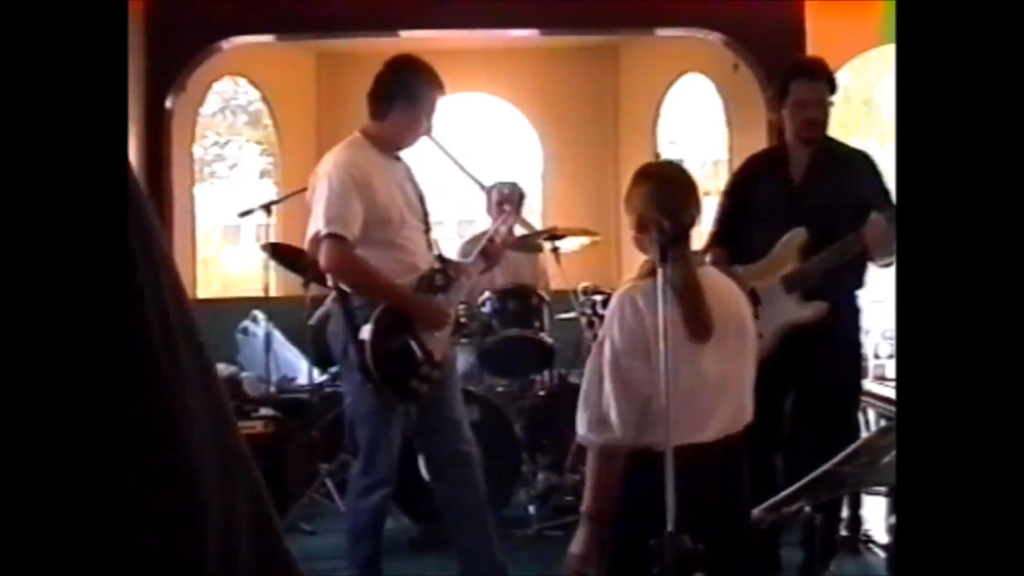
Brendon McAliece is a multi lingual expatriate Australian living in Thailand who speaks Thai, a number of its dialects and Lao. He has been playing guitar since he was 12 and continues to do so to this day.
He has performing in bands across the Middle East while contracting as a Aircraft Weapons Instructor with his 10 years of RAAF Armament Fitter experience and his maintained his love for playing guitar it continues to thrive today.
Also Visit:
DreamingGuitar.com – DreamingCoffee.com – LetsFlyVFR.com
As an Amazon affiliate I may earn on qualifying sales.
Leave a Reply